Gallery interior with raking natural light on white walls

Fine Art Photography

Joshua Lake

Curating a Creative Legacy: Lessons from Early Portfolio Practice
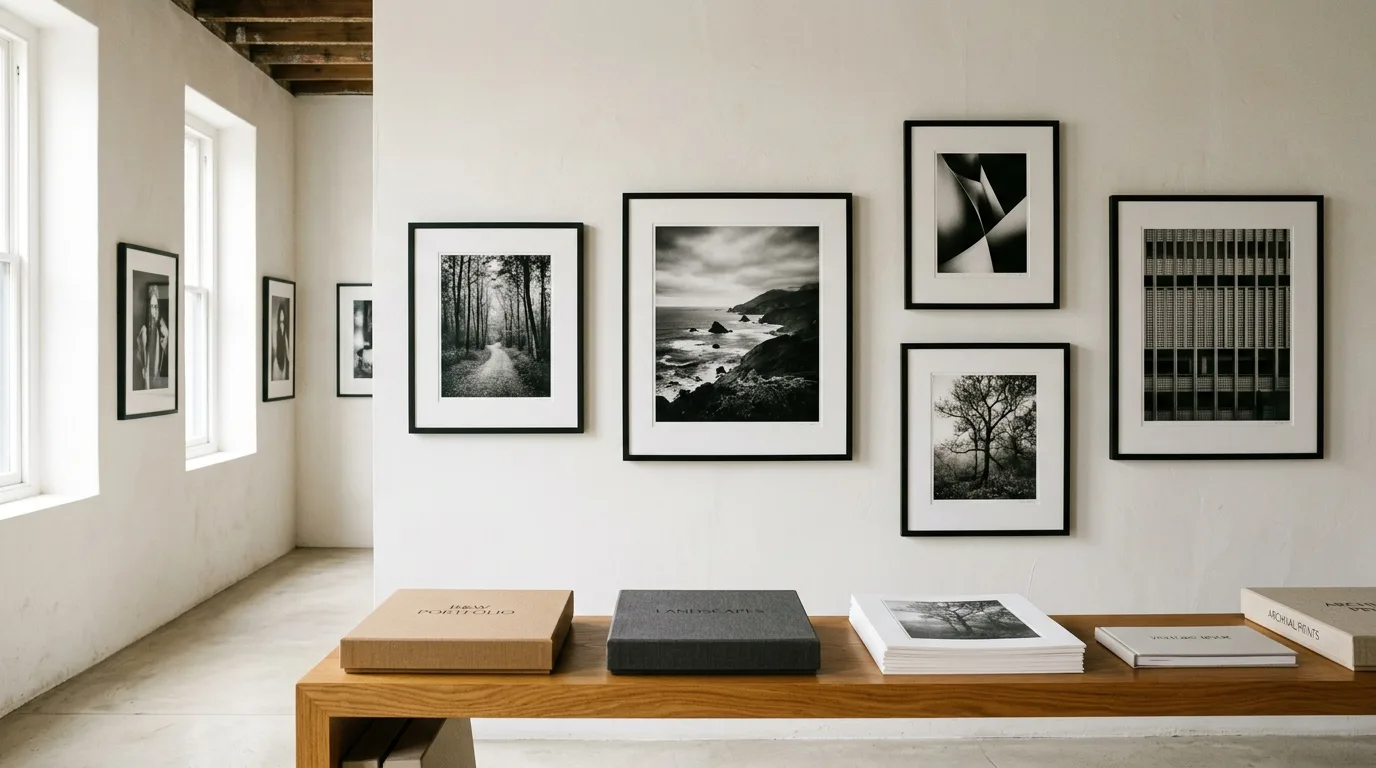
Fine art photographic prints arranged in a clean gallery space with warm white walls

Curation is an act of argument. Every decision about what to include, what to exclude, and in what order to present work makes a claim about what the work means and what it is for. The artist who curates their own portfolio is doing something that goes beyond organizing files or building a website. They are constructing a narrative about their practice, positioning their work within a field, and making choices about which aspects of their development are legible and which are held back.

These decisions are consequential. The portfolio is often the primary way that new audiences encounter an artist’s work, and the frame it constructs shapes every encounter that follows. Getting the curation right (or close enough to right that it invites genuine engagement) is one of the most demanding and undervalued skills in artistic practice.

What a Portfolio Actually Does

A portfolio is not a neutral container. It does not simply display work; it argues for a particular understanding of that work. The sequence in which images are presented, the weight given to different series or projects, the visual relationships between works placed in proximity to each other: all of these are interpretive decisions with real consequences.

In the context of fine art photography and conceptual practice, the portfolio often needs to accomplish several things simultaneously. It needs to demonstrate technical and formal competence to viewers with professional interests: gallerists, curators, editorial clients. It needs to communicate a coherent sensibility to viewers who are encountering the artist for the first time and are forming first impressions quickly. And it needs to function as a record for the artist themselves, a document of where the practice has been and what it has produced.

These demands can pull in different directions. The work that most clearly demonstrates technical range may not be the work that most clearly communicates the artist’s central concerns. The project that feels most important to the artist may be the one that is hardest for a first-time viewer to enter. The curation process involves making principled choices about how to balance these competing pressures.

The Digital Portfolio as Exhibition Space

The emergence of the personal website as a primary venue for artistic presentation in the early 2010s represented a genuine shift in how visual artists could position and distribute their work. For the first time, an artist could construct a complete exhibition environment, with full control over sequencing, context, and the physical experience of navigation, without requiring access to institutional or gallery space.

This was a significant democratization, but it came with its own set of challenges. The conventions of gallery exhibition, developed over decades, provided clear frameworks for how work should be presented and encountered. The personal website offered radical freedom alongside radical ambiguity. What were the conventions for navigating a digital portfolio? How long would a visitor spend on any given page? What relationships between images were created by the architecture of a site as opposed to the architecture of a gallery wall?

Artists who navigated this period most effectively often treated their websites as conceptual objects in their own right, not merely as repositories for existing work but as environments designed to produce particular experiences of that work. The structure of the site, its visual language, its interface conventions were all understood as part of the artistic statement.

Selection and Restraint

One of the most common errors in portfolio curation is inclusion of too much work. The instinct to show everything is understandable: the artist has invested time and energy in each piece, and exclusion feels like a kind of abandonment. But a portfolio weighted down with work that does not represent the artist at their best dilutes the impact of the strongest pieces.

Restraint is curatorial argument. When an artist shows fifteen images instead of fifty, they are claiming that these fifteen images are sufficient to communicate what is essential about the practice. That claim will be tested by viewers, and if the selection is right, the test will be passed. The viewer who has encountered a carefully edited portfolio and been compelled by it will want to see more, will seek out other contexts in which the work appears, will begin to understand the portfolio as a threshold rather than a complete statement.

The question of how much to show is related to but distinct from the question of what to show. An artist might have a smaller body of work that requires showing everything to give a complete picture, or a large body of work from which a tight selection communicates more effectively than any broader sample could. Context (the career stage of the artist, the audience being addressed, the purpose of the particular portfolio iteration) determines the appropriate scope.

Sequencing as Argument

The order in which works appear in a portfolio is not incidental. Sequence creates expectation and then either fulfills or subverts it. The first image in a portfolio sets terms for everything that follows; the last image leaves the viewer with a final impression that shapes how they retrospectively interpret everything they have seen.

Between these two anchors, the internal structure of the portfolio builds its argument through association, contrast, and momentum. Two images that share a formal quality placed in sequence invite comparison; the viewer looks for what they share and what distinguishes them. An image placed after a sequence of closely related works that departs markedly from that sequence creates disruption. The disruption may be productive, opening up the range of the practice, or it may be disorienting in ways that undermine coherence.

Artists who have thought carefully about sequence often develop portfolio structures that allow for multiple valid paths through the work, where the same pieces can be encountered in different orders without the underlying argument collapsing. This kind of structural resilience is particularly important for digital portfolios, where visitors rarely follow the path the artist has designed in its entirety.

The Portfolio as Living Document

A mature artistic practice generates new work continuously, and the portfolio must be understood as a living document rather than a fixed record. The curation that was right for a practice at one stage of development will need revision as the practice evolves. Projects that seemed central may recede in importance; work that seemed peripheral may turn out to have been more significant than was understood at the time.

This means that curation is not a task to be completed but a practice to be maintained. Returning to the portfolio with fresh eyes at regular intervals, ideally with some critical distance from the most recently made work, is part of the discipline of a serious artistic practice. The artist who last curated their portfolio four years ago and has not revisited it since is presenting a version of themselves that may no longer be accurate.

The challenge is to maintain stability in the portfolio, so that the work builds a recognizable identity over time, while allowing for genuine revision. This balance requires a certain confidence: the ability to hold the current curation provisionally, to remain open to the possibility that it could be improved, without falling into the paralysis of perpetual rearrangement.

Legacy and the Long View

Artists who sustain a practice over decades come to understand the portfolio differently than they did in the early stages of their career. The question shifts from “how do I present this work to get opportunities?” toward “how does this body of work represent a life spent attending to certain questions?”

This longer view changes the criteria for curation. Work that seemed to fail in the immediate context of its making may be revalued when seen in relation to later work that it quietly prefigured. Projects that felt minor may turn out to have been where the most important formal developments happened. The arc of a practice, visible only from a sufficient temporal distance, can be as meaningful as any individual series within it.

Attending to the portfolio as a record of a life in practice, not just a marketing document or an exhibition selection, is one of the ways in which curation becomes a genuinely artistic act. It is the artist’s argument, made across time, about what mattered and why.


See also: Exploring Identity Through Conceptual Photography and The Role of Experimental Series in Building an Artist’s Identity.
The Role of Experimental Series in Building an Artist's Identity

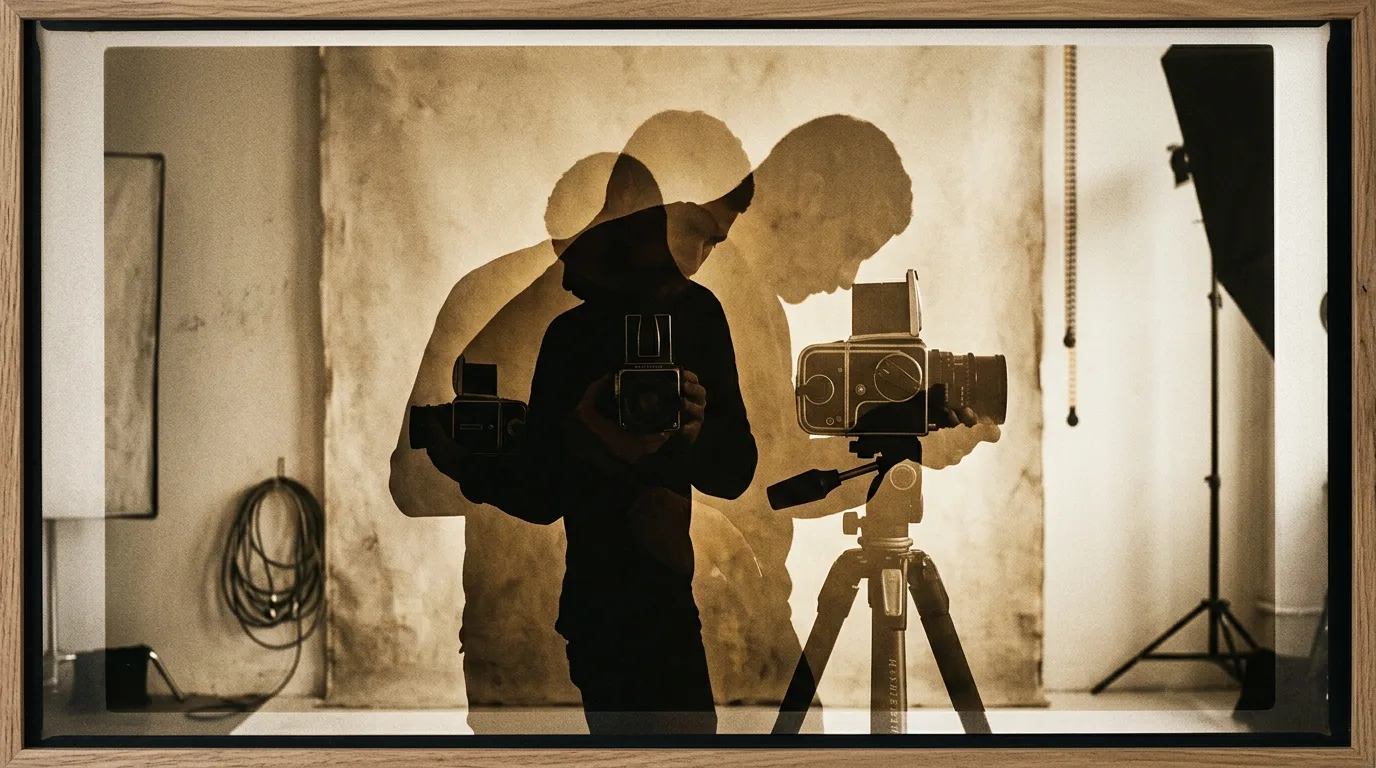
Photographer in minimal studio with overlapping silhouette multiple exposure effect

There is a tendency, particularly in the culture surrounding creative careers and portfolio development, to focus on finished works, on the polished object that can be displayed, sold, or cited as evidence of achievement. This tendency is understandable, and it is not without value. But it can obscure the process through which a distinctive artistic identity actually forms: the accumulation of experimental work, the series that pushes an idea past its comfortable resolution, the projects that fail in instructive ways.

Experimental series are the laboratory of serious art practice. They are where an artist discovers not just what they can make, but what they are genuinely interested in making and why. The work that emerges from sustained experimental engagement often looks quite different from what the artist imagined when they began, and that difference is the point.

What Makes a Series Experimental

The word “experimental” is applied freely and not always usefully. In the context of fine art photography and conceptual practice, an experimental series is one in which the outcome is not predetermined, where the artist sets up conditions for discovery rather than executing a preformed plan.

This is a meaningful distinction. A well-crafted series with a defined concept and a clear visual language is not experimental in this sense; it is the result of experimentation that has been brought to resolution. The experimental phase is what precedes that resolution, the period in which the artist is working in genuine uncertainty about what the piece will become.

Experimental work often involves the deliberate introduction of constraints. A constraint (a rule about what the camera position will be, what the color palette can include, what types of subjects will be included or excluded) creates a bounded space within which unexpected things can happen. The constraint is not a limitation on creativity but a generator of it.

Rules as Creative Instruments

“The Rulebook,” as an artistic project, makes explicit something that is implicit in all experimental practice: the work is governed by rules, and the rules themselves are a subject. What rules determine how a photograph is made? What rules govern how images are sequenced? What rules does the viewer bring to the act of looking, and what happens when those rules are violated or confirmed?

Working explicitly with rules as subject matter connects contemporary art practice to a long tradition of conceptual art that foregrounds process and system. Sol LeWitt’s wall drawings, for instance, are defined by instructions that others execute. The work is the instruction set; the installation is its manifestation. This approach shifts attention from the hand of the artist to the logic of the system, and that shift produces work that can be endlessly varied while remaining conceptually coherent.

For the photographer working in a documentary or portraiture tradition, introducing explicit rules into the process can produce a defamiliarizing effect. What seems like a straightforward image becomes strange when the viewer understands that it was made under constraint, such that the range of what the photographer could do was deliberately narrowed, and what appears in the frame is therefore the result of both choice and limitation.

Identity Through Accumulation

An artist’s identity (in the sense of a recognizable sensibility, a set of persistent concerns, a characteristic way of approaching problems) does not emerge fully formed. It develops through the accumulation of work, and particularly through the accumulation of work that takes risks.

The risk in experimental practice is real. A series that genuinely explores uncertain territory will sometimes produce work that does not succeed on its own terms. The artist has to be willing to make that work, to learn from it, and to move forward with the knowledge gained even when the resulting images are not ones they would want to exhibit. This willingness to work through failure is a professional practice, not a personal failing.

Over time, patterns emerge from the accumulation of experiments. The artist begins to notice which problems generate the most productive uncertainty, which formal approaches feel native to their sensibility, which questions they return to across different projects. These patterns are the raw material of artistic identity, not a brand or a style applied from outside, but an identity arrived at through making.

The Role of Platform and Context

The context in which experimental work is presented shapes how it is received and understood. A series developed in the relative privacy of a personal practice and then shared through a digital portfolio reaches audiences in a different register than work developed for a specific gallery context or institutional commission.

Digital platforms extended the reach of experimental practice significantly in the early 2010s. Artists who might previously have shared work only with a local community of peers could now reach audiences internationally, receive feedback across geographic and cultural contexts, and encounter work from other artists that challenged or complicated their own assumptions. Platforms like Behance and Flickr functioned as distributed exhibition spaces as much as social networks.

This access changed the temporality of experimental work. Rather than holding a series in the studio until it reached a definitive resolution, artists could share work in progress, observe responses, and allow those responses to inform the development of the series. The experimental process became, in some cases, a semi-public one.

Series as Self-Portrait

There is a sense in which every series an artist makes is a self-portrait, not necessarily in the sense that the artist appears in the work, but in the sense that the series is a record of a sustained engagement with a problem at a particular moment in the artist’s development. The formal choices, the subjects selected, the quality of attention brought to the work: these are all legible as evidence of who the artist was when the work was made and what they cared about.

This is true of work that appears to have nothing to do with the artist’s biography or inner life. A landscape series is as much a record of the photographer’s way of seeing as a series of explicit self-portraits. The camera is always pointing in two directions at once.

For artists who work across multiple series over years or decades, the body of work as a whole becomes a kind of autobiography, not a linear narrative, but a collection of sustained engagements with questions that were alive for the artist at different points in their practice. The viewer who takes the time to look at the whole body of work encounters not just individual projects but the arc of a developing sensibility.

Moving Forward from Experimentation

The experimental series that generates genuine discovery will eventually reach a point of productive exhaustion, a point at which the central questions have been worked through as far as the current approach can take them, and the artist is ready to move into new territory. Recognizing this moment is itself a skill that develops through practice.

The transition from one series or project to the next is rarely a clean break. Elements of previous work persist in new projects, transformed by the artist’s development but still recognizable to an attentive viewer. The conversation between past and present work is one of the things that gives a mature artistic practice its depth and coherence.

What the experimental series ultimately produces, beyond whatever individual images emerge from it, is an artist who has been changed by the process of making, with more nuanced questions, more developed technical capacities, and a clearer sense of what kind of work is genuinely theirs to make.


See also: Exploring Identity Through Conceptual Photography and Curating a Creative Legacy: Lessons from Early Portfolio Practice.

Exploring Identity Through Conceptual Photography

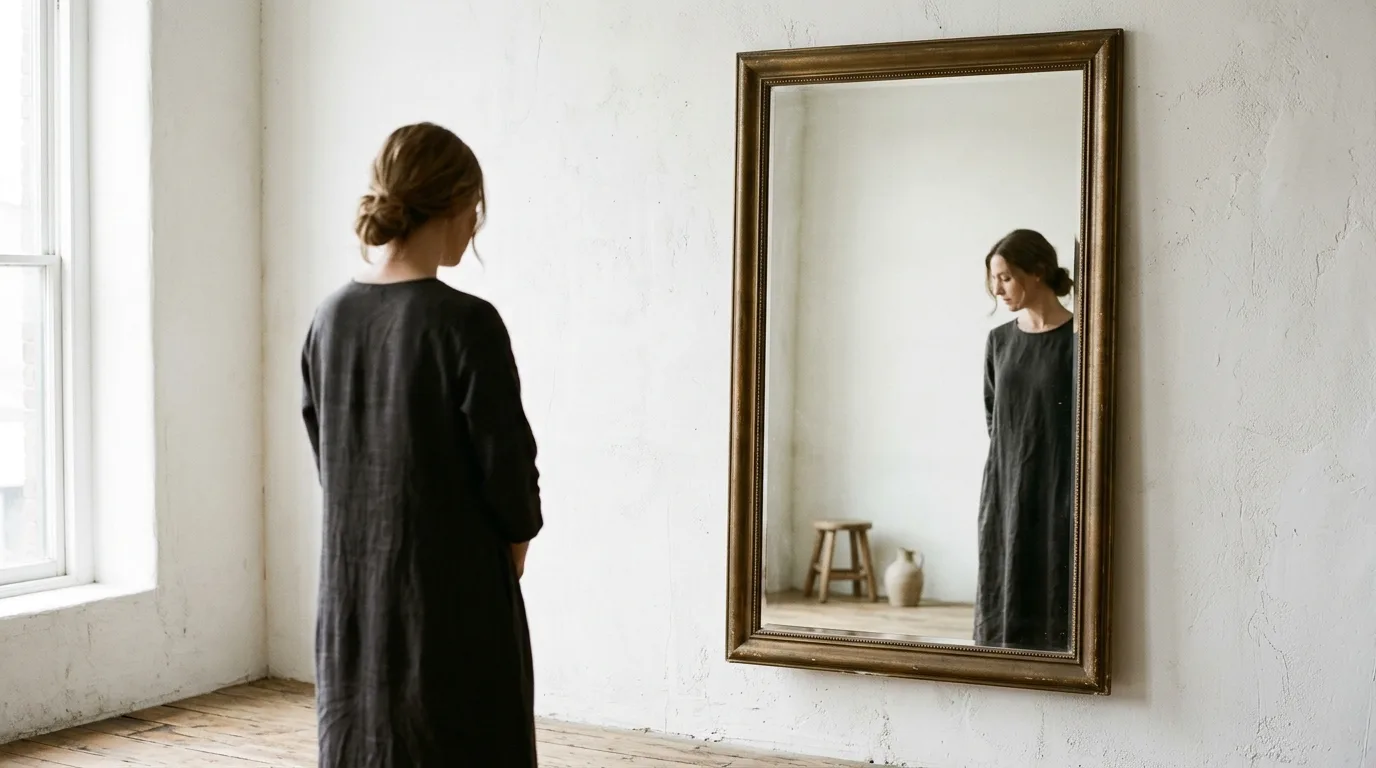
Figure reflected in a large studio mirror, soft natural light, gallery minimal composition

Photography has always carried within it the tension between documentation and invention. A photograph records what was in front of the lens at a given moment, and yet any working photographer or attentive viewer knows that the camera does not capture reality so much as it proposes one. Nowhere is this tension more productively exploited than in conceptual photography, where the image is not an end in itself but a vehicle for an idea, an argument made with light rather than words.

For artists working at the intersection of fine art and photography, questions of identity form a persistent and generative subject. Who is the person in the frame? Who constructed that person? What does the body, the face, the gaze reveal or withhold? These are not new questions, but the photographic medium makes them viscerally present in ways that paint or sculpture can approach only indirectly.

The Portrait as Construction

The portrait tradition carries enormous cultural weight. For centuries, portraiture was the domain of royalty, clergy, and the affluent, images commissioned to project status, legitimacy, and a carefully managed idea of personhood. Photography democratized the portrait but did not dissolve its constructedness. Every portrait is still a negotiation: between subject and photographer, between the moment captured and the narrative implied.

Conceptual portraiture takes this negotiation into explicit territory. Rather than pretending to a transparent window onto the subject, the conceptual photographer foregrounds the frame itself. Props, staging, color, scale, repetition, and sequencing all become legible parts of the work’s argument. The viewer is never allowed to forget that they are looking at a made thing.

Artists working in this mode frequently draw on the body as raw material, not to objectify it, but to question what it means to present a body at all. Clothing, posture, gaze direction, and spatial relationship to the camera carry semantic weight that the artist can load, subvert, or deliberately empty. The result is portraiture that asks the viewer to work, to bring their own interpretive frames into contact with those of the artist.

Series as Method

The single image has enormous power, but conceptual work in photography often demands the series as its primary unit of meaning. A series allows for accumulation, variation, and internal dialogue. The viewer who moves through ten images in a sequence experiences something qualitatively different from what any individual image in that sequence could produce alone.

Seriality introduces the possibility of rule and deviation. An artist might establish a formal constraint (a fixed camera position, a single backdrop color, a set of repeated gestures) and then work within and against that constraint to generate meaning. The constraint itself becomes legible as a statement. In the context of identity, this is particularly resonant: the rules that govern how a self is presented, how it is recognized, how it is legible within social codes, are themselves a subject worth examining.

Projects built around seriality also make visible the passage of time, the mutability of the subject, and the limits of any single representation. A face photographed ten times is not the same face ten times. It is ten distinct proposals about what a face is.

The Interior Made Visible

Some of the most compelling conceptual photography of the last two decades has been preoccupied with the relationship between interior experience and outward appearance. How does the inner life show itself? Can an image render psychological states, memories, or emotional histories visible without collapsing into illustration?

This line of inquiry produces work that resists easy legibility. Rather than illustrating a feeling, the artist creates conditions in which feeling can arise in the viewer, through compositional tension, through the uncanny, through scale relationships that unsettle normal perceptual expectations. The work operates obliquely, trusting the image to carry more than a caption could explain.

The series titled “Inside Out,” associated with Joshua Lake’s early portfolio, exemplifies this approach. The title itself announces the inversion: what is normally interior is brought to the surface, and what appears on the surface is understood to have depths. The photographic image, which can only record surfaces, becomes a site for exploring what lies beneath them.

Eye Maps and the Topology of Seeing

The eye is among the most intensively symbolized organs in Western art. It carries associations with soul, with truth, with surveillance, with vulnerability. In fine art photography, the close-up of the eye or the face becomes a site of concentrated meaning (too much meaning, sometimes) and the artist must work against accumulated symbolism to clear space for a fresh proposition.

The “Eye Maps” project suggests cartography applied to the organ of vision itself. To map the eye is to treat it as terrain rather than as window, as a surface with topography, with zones of particular density or sparseness, with edges and interiors. This inversion of the usual semiotic function of the eye in portraiture is characteristic of conceptual work that approaches familiar subjects from unexpected angles.

Photography’s relationship to vision is inherently reflexive. The camera is an eye, or a prosthetic eye, or an artificial eye depending on the metaphor the artist finds most useful. A project that takes the eye as its explicit subject cannot avoid this reflexivity. The viewer looking at an image of an eye is caught in a loop: seeing, depicted as seeing, seen.

Building a Body of Work

For the artist working across multiple series and projects, the question of coherence arises. What holds a portfolio together when individual projects differ in subject matter, formal approach, and emotional register? In conceptual practice, coherence is often found not in visual consistency but in persistent underlying concerns.

An artist might return again and again to questions of visibility and concealment, or to the relationship between the body and the systems that classify and regulate it, or to the way personal history inscribes itself on material objects. These concerns generate varied visual work while maintaining a recognizable intellectual and ethical orientation.

The portfolio, in this reading, is not a collection of finished objects but an ongoing argument, a body of evidence for the artist’s sustained engagement with particular questions. Each new project is both a response to the previous work and an opening toward what has not yet been addressed.

Conceptual Photography and the Viewer

Conceptual work places demands on viewers that purely aesthetic photography does not. It asks for a willingness to sit with uncertainty, to hold multiple interpretations simultaneously, and to remain curious about what the work is doing rather than immediately categorizing it. This is not a failing of accessibility but a deliberate structure built into the work.

The reward for this kind of sustained looking is significant. Work that initially resists easy interpretation often yields rich returns to the viewer who returns to it. The meaning is not exhausted in a single encounter. It accumulates across viewings, across conversations with other work, across the viewer’s own changing experiences and knowledge.

This is, ultimately, what distinguishes conceptual photography from more immediately legible image-making. Not superiority, but a different relationship to time and to the experience of meaning-making itself. The image proposes; the viewer completes it.


See also: The Role of Experimental Series in Building an Artist’s Identity and Curating a Creative Legacy: Lessons from Early Portfolio Practice.